railwayrailway
World Cup 2026 spurs transport investment: Monterrey monorail project delayed as Mexico City upgrades key infrastructure
By Urban Transport Magazine – Rail/Metro•06-06-2026June 06, 2026•8 min
Urban Transport Magazine – Rail/Metro•06-06-2026June 06, 2026•8 min railway
The 2026 FIFA World Cup is set to become the largest football tournament in history. For the first time, 48 teams will compete in a total of 104 matches. The tournament will be hosted across 16 cities in three countries – the United States, Canada and Mexico. While the United States will stage the majority of matches, hosting 78 games, Mexico and Canada will each host 13 fixtures. In Mexico, matches will be played in Mexico City, Guadalajara and Monterrey, with the opening match scheduled to take place on 11 June 2026 at the modernised Estadio Azteca in Mexico City.
The World Cup is not only a major sporting event but also a catalyst for infrastructure investment. In particular, host cities are using the international spotlight to advance long-planned transport projects and modernise their mobility systems. While Monterrey is pursuing one of the country’s most ambitious public transport schemes with the construction of the fully automated Monorail Lines 4 and 6, Mexico City is investing in the upgrading of key transport interchanges such as Tasqueña. Both projects underline the role of the World Cup as an accelerator of urban infrastructure development – even though, particularly in Monterrey, it is becoming evident that even a fixed tournament deadline is not always sufficient to deliver complex megaprojects on time.
The United States and Canada are focusing on capacity enhancements rather than major new infrastructure projects. In contrast to Mexico, where several high-profile rail schemes are being advanced in direct connection with the tournament, most host cities in North America are relying on incremental upgrades to existing networks. These include increased service frequencies, expanded bus and shuttle operations, temporary dedicated transit lanes, and operational improvements aimed at managing peak demand during the event period. While a small number of rail extensions and light rail projects will be completed in time for the World Cup, the overall strategy in the US and Canada is centred on optimising and intensifying the use of existing public transport systems rather than delivering large-scale new build infrastructure.
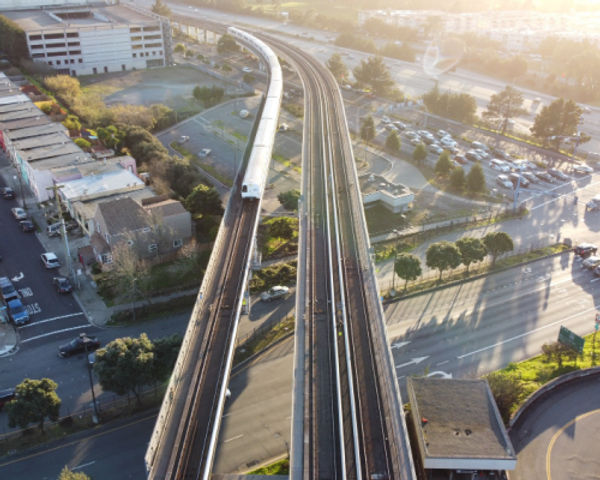
With a combined length of approximately 34.3 km, Monterrey’s new Monorail Lines 4 and 6 rank among the largest urban elevated rail projects currently under development in Latin America. Designed as a fully automated straddle-beam monorail system, the network is intended to become a key component of public transport in the Monterrey metropolitan area. However, with the FIFA World Cup 2026 approaching, the project is under significant time pressure, with increasingly evident implications for its opening schedule.
Monterrey’s monorail system is based on the Innovia Monorail 300 platform, originally developed by Bombardier Transportation and now part of Alstom’s portfolio. However, the vehicles for Lines 4 and 6 are not manufactured by Alstom itself, but by CRRC Nanjing Puzhen, with Chinese industry drawing on the licensed and further developed Innovia technology. The project therefore represents a cooperative product within a globalised supply chain: Alstom provides the system platform and core technological design, while CRRC is responsible for series production and parts of the system integration. For Monterrey, this results in a fully automated straddle-beam monorail system operating at GoA4 level, whose technical lineage combines European system development with Chinese industrial manufacturing capacity, exemplifying the increasingly hybrid nature of modern urban rail projects.
The lines comprise approximately 20 stations and a wide range of large-scale infrastructure elements, including elevated guideways, ramps and station structures. Total investment is estimated at around US$1.3–1.5 billion, covering rolling stock, civil works and electromechanical systems.
The trains are approximately 76 m long and consist of six-car formations with a capacity of around 700 to 720 passengers. They are fully electrified and designed for unattended operation to GoA4 standards. Planned headways of between 75 and 90 seconds would theoretically enable very high line capacity. With a maximum operating speed of around 80 km/h, the vehicles are specifically designed for busy urban corridors and anticipated peak passenger demand associated with major events such as the FIFA World Cup.
A video about the test runs and technology of the “monorail”, as it is known in Spanish, can be found here:
Overall construction progress reached approximately 70% to 75% by early 2026. While much of the civil infrastructure is visibly complete, installation and integration of the technical systems remain ongoing. These include signalling, power supply systems and rolling stock commissioning.
A key element of the project is an approximately 11 km section between Citadel in San Nicolás and Parque Fundidora, which has been designated as a demonstration and testing corridor. This section is expected to enter limited test operation ahead of the World Cup, although it will not carry passengers.
Alongside Lines 4 and 6, Line 5 was originally planned in Monterrey as a further extension of the metro network. It was intended to connect additional residential and development areas in the southern and south-eastern parts of the city, but was revised several times during the project prioritisation process and was ultimately put on hold. In addition to budgetary constraints, ongoing protests by local residents along the originally planned route also played a role, these protests were primarily directed against compulsory purchase, disruption to established streetscapes, and the structural impact of an additional elevated railway project. As an alternative solution, a system comprising electric buses and DRT-style services (Demand Responsive Transport) is now planned, which will respond more flexibly to the existing road network and improve access in the corridor without the need for large-scale infrastructure works. This shifts the original rail-based focus of Line 5 towards a bus-based, electrified and more flexible operating model.
Earlier plans envisaged opening at least part of the monorail network before the FIFA World Cup. These expectations have since been scaled back considerably. Although sections of the infrastructure are expected to be technically complete, commercial passenger operation will not commence in time for the tournament. Instead, the focus has shifted towards extensive testing and validation activities. Full commissioning of the network is now considered more realistic during 2027.
The causes of the delays are multifaceted. In addition to the inherent complexity of constructing elevated infrastructure within densely developed urban corridors, extensive utility relocation works (‘obra inducida’) have significantly affected the programme. Further challenges include the simultaneous construction of major structures such as bridges and stations, supply-chain dependencies for specialised monorail components, and the demanding integration of fully automated train control and signalling systems.
For the World Cup, the monorail will remain a highly visible symbol of infrastructure modernisation, but without playing an operational role in passenger transport. Spectator and commuter movements will continue to rely primarily on the existing metro network, bus corridors and road infrastructure. As a result, the monorail is likely to serve as a long-term capacity enhancement rather than a short-term World Cup transport solution.
Located in the south of Mexico City, Tasqueña station serves as the southern terminus of Metro Line 2 and is simultaneously one of the most important multimodal transport interchanges in the metropolitan area. It connects the metro system with urban bus services and long-distance coach operations serving destinations in the states of Morelos and Guerrero.
As part of ongoing modernisation works, the station has undergone a functional reorganisation aimed at improving the handling of high daily passenger volumes and reducing transfer times between metro and bus services. Measures include improved pedestrian circulation, upgraded access points and a clearer separation of the various transport modes within the terminal complex.
Handling several hundred thousand passengers per day, Tasqueña functions as the principal southern gateway to the Mexico City metropolitan area. By linking the high-capacity metro network with regional and intercity coach services, the station plays a key role in integrating urban and regional mobility across one of the world’s largest metropolitan regions.
In recent months, attention has been drawn to the design of several vehicles in Mexico City’s trolleybus system featuring the axolotl (ajolote), an endemic salamander species from the Valley of Mexico and one of the capital’s most recognisable symbols. Both vehicles operated by the Servicio de Transportes Eléctricos (STE) trolleybus network and units of the city’s light rail system (Tren Ligero) have been given large-scale special liveries depicting stylised axolotl motifs. The campaign aims to raise awareness of the species’ endangered status while also increasing the visibility of electric public transport in the city.
The initiative has received a generally positive response from many passengers, as it enhances the visibility of the vehicles and creates a link between urban mobility and local natural and cultural heritage. At the same time, the campaign has not been without criticism. In particular, social media discussions and passenger groups have questioned whether financial resources allocated to design campaigns might be better directed towards improving operational performance. Critics point to ongoing challenges such as overcrowding, network delays and the need to modernise certain infrastructure assets. Supporters, however, argue that the relatively modest cost of the liveries is negligible compared with overall investment levels in rolling stock and infrastructure, and that the campaign helps raise public awareness of a highly endangered species.
Regardless of the debate, the “Ajolotes” highlight a notable shift in the self-perception of STE. While electric transport systems in Mexico City have traditionally been regarded primarily as functional modes of transport, the operator is increasingly placing emphasis on stronger branding and emotional engagement with passengers. The combination of an iconic local species with modern electric public transport thus also reflects an attempt to more closely link sustainability, local identity and public transport in the urban context.
Recent Comments
0
Loading related news…